

Running
2
Qstn Gui
💻
GUI for the QSTN Framework
None defined yet.
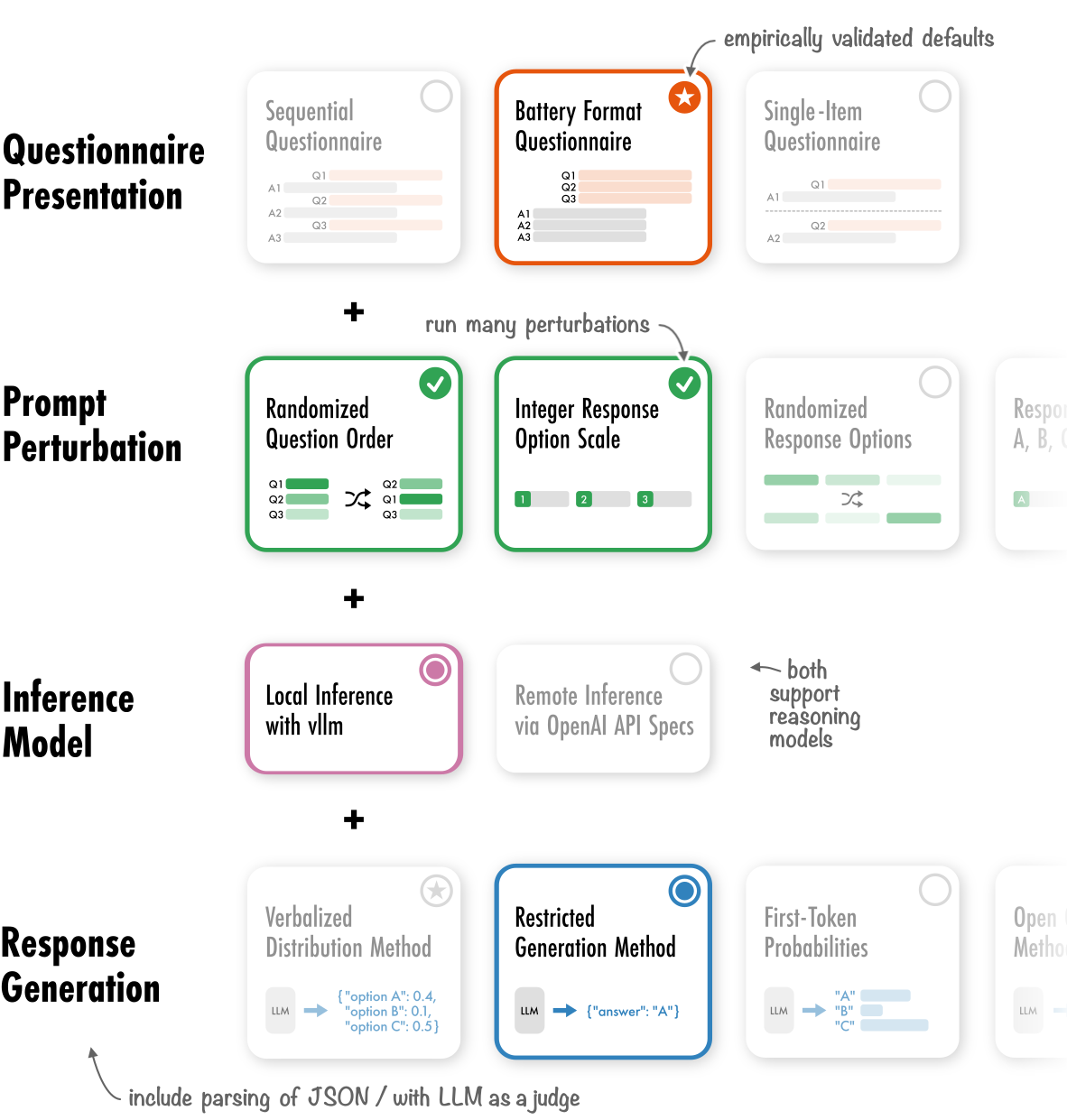
QSTN is a Python framework designed to facilitate the creation of robust inference experiments with Large Language Models based around questionnaires. It provides a full pipeline from perturbation of prompts, to choosing Response Generation Methods, inferencing and finally parsing of the output. QSTN supports both local inference with vllm and remote inference via the OpenAI API.
Detailed information and guides are available in our documentation. Tutorial notebooks can also be found in this repository.
To install the project and dependencies you can use pip.
pip install qstn
Or install this package from source:
pip install git+https://github.com/dess-mannheim/QSTN.git
Below you can find a minimum working example of how to use QSTN. It can be easily integrated into existing projects, requiring just three function calls to operate. Users familiar with vllm or the OpenAI API can use the same Model/Client calls and arguments. In this example reasoning and the generated response are automatically parsed. For more elaborate examples, see the tutorial notebooks.
import qstn
import pandas as pd
from vllm import LLM

# 1. Prepare questionnaire and persona data
questionnaires = pd.read_csv("hf://datasets/qstn/ex/q.csv")
personas = pd.read_csv("hf://datasets/qstn/ex/p.csv")
prompt = (
    f"Please tell us how you feel about:\n"
    f"{qstn.utilities.placeholder.PROMPT_QUESTIONS}"
)
interviews = [
    qstn.prompt_builder.LLMPrompt(
        questionnaire_source=questionnaires,
        system_prompt=persona,
        prompt=prompt,
    ) for persona in personas.system_prompt]

# 2. Run Inference
model = LLM("Qwen/Qwen3-4B", max_model_len=5000)
results = qstn.survey_manager.conduct_survey_single_item(
    model, interviews, max_tokens=500
)

# 3. Parse Results
parsed_results = qstn.parser.raw_responses(results)
If you find QSTN useful in your work, please cite our paper:
@misc{kreutner2025qstnmodularframeworkrobust,
      title={QSTN: A Modular Framework for Robust Questionnaire Inference with Large Language Models},
      author={Maximilian Kreutner and Jens Rupprecht and Georg Ahnert and Ahmed Salem and Markus Strohmaier},
      year={2025},
      eprint={2512.08646},
      archivePrefix={arXiv},
      primaryClass={cs.CL},
      url={https://arxiv.org/abs/2512.08646},
}