| --- |
| language: rna |
| tags: |
| - Biology |
| - RNA |
| license: |
| - agpl-3.0 |
| size_categories: |
| - 1K<n<10K |
| task_categories: |
| - text-generation |
| - fill-mask |
| task_ids: |
| - language-modeling |
| - masked-language-modeling |
| pretty_name: EternaBench-CM |
| library_name: multimolecule |
| --- |
| |
| # EternaBench-CM |
|
|
|  |
|
|
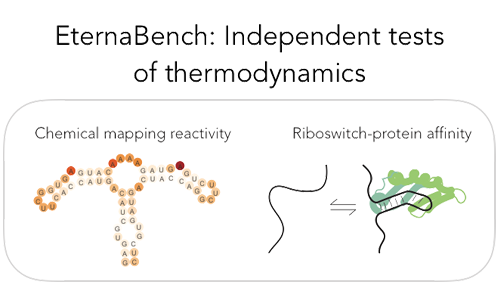
| EternaBench-CM is a synthetic RNA dataset comprising 12,711 RNA constructs that have been chemically mapped using SHAPE and MAP-seq methods. |
| These RNA sequences are probed to obtain experimental data on their nucleotide reactivity, which indicates whether specific regions of the RNA are flexible or structured. |
| The dataset provides high-resolution, large-scale data that can be used for studying RNA folding and stability. |
|
|
| ## Disclaimer |
|
|
| This is an UNOFFICIAL release of the [EternaBench-CM](https://github.com/eternagame/EternaBench) by Hannah K. Wayment-Steele, et al. |
|
|
| **The team releasing EternaBench-CM did not write this dataset card for this dataset so this dataset card has been written by the MultiMolecule team.** |
|
|
| ## Dataset Description |
|
|
| - **Homepage**: https://multimolecule.danling.org/datasets/eternabench_cm |
| - **datasets**: https://huggingface.co/datasets/multimolecule/eternabench-cm |
| - **Point of Contact**: [Rhiju Das](https://biochemistry.stanford.edu/people/rhiju-das) |
| |
| The dataset includes a large set of synthetic RNA sequences with experimental chemical mapping data, which provides a quantitative readout of RNA nucleotide reactivity. These data are ensemble-averaged and serve as a critical benchmark for evaluating secondary structure prediction algorithms in their ability to model RNA folding dynamics. |
| |
| ## Example Entry |
| |
| | index | design | sequence | secondary_structure | reactivity | errors | signal_to_noise | |
| | -------- | ---------------------- | ---------------- | ------------------- | -------------------------- | --------------------------- | --------------- | |
| | 769337-1 | d+m plots weaker again | GGAAAAAAAAAAA... | ................ | [0.642,1.4853,0.1629, ...] | [0.3181,0.4221,0.1823, ...] | 3.227 | |
|
|
| ## Column Description |
|
|
| - **id**: |
| A unique identifier for each RNA sequence entry. |
| |
| - **design**: |
| The name given to each RNA design by contributors, used for easy reference. |
| |
| - **sequence**: |
| The nucleotide sequence of the RNA molecule, represented using the standard RNA bases: |
| |
| - **A**: Adenine |
| - **C**: Cytosine |
| - **G**: Guanine |
| - **U**: Uracil |
|
|
| - **secondary_structure**: |
| The secondary structure of the RNA represented in dot-bracket notation, using up to three types of symbols to indicate base pairing and unpaired regions, as per bpRNA's standard: |
| |
| - **Dots (`.`)**: Represent unpaired nucleotides. |
| - **Parentheses (`(` and `)`)**: Represent base pairs in standard stems (page 1). |
| - **Square Brackets (`[` and `]`)**: Represent base pairs in pseudoknots (page 2). |
| - **Curly Braces (`{` and `}`)**: Represent base pairs in additional pseudoknots (page 3). |
| |
| - **reactivity**: |
| A list of normalized reactivity values for each nucleotide, representing the likelihood that a nucleotide is unpaired. |
| High reactivity indicates high flexibility (unpaired regions), and low reactivity corresponds to paired or structured regions. |
| |
| - **errors**: |
| Arrays of floating-point numbers indicating the experimental errors corresponding to the measurements in the **reactivity**. |
| These values help quantify the uncertainty in the degradation rates and reactivity measurements. |
| |
| - **signal_to_noise**: |
| The signal-to-noise ratio calculated from the reactivity and error values, providing a measure of data quality. |
| |
| ## Related Datasets |
| |
| - [eternabench-switch](https://huggingface.co/datasets/multimolecule/eternabench-switch) |
| - [eternabench-external.1200](https://huggingface.co/datasets/multimolecule/eternabench-external.1200): EternaBench-External dataset with maximum sequence length of 1200 nucleotides. |
| |
| ## Preprocess |
| |
| The MultiMolecule team preprocess this dataset by the following steps: |
| |
| 1. Remove all sequence whose `signal_to_noise < 1`. |
| 2. Remove all sequence without proper secondary structure (i.e., the secondary structure in dot-bracket notation do not match). |
| 3. Padding/truncating all chemical measurements to sequence length. |
| |
| ## License |
| |
| This dataset is licensed under the [AGPL-3.0 License](https://www.gnu.org/licenses/agpl-3.0.html). |
| |
| ```spdx |
| SPDX-License-Identifier: AGPL-3.0-or-later |
| ``` |
| |
| ## Citation |
| |
| ```bibtex |
| @article{waymentsteele2022rna, |
| author = {Wayment-Steele, Hannah K and Kladwang, Wipapat and Strom, Alexandra I and Lee, Jeehyung and Treuille, Adrien and Becka, Alex and {Eterna Participants} and Das, Rhiju}, |
| journal = {Nature Methods}, |
| month = oct, |
| number = 10, |
| pages = {1234--1242}, |
| publisher = {Springer Science and Business Media LLC}, |
| title = {{RNA} secondary structure packages evaluated and improved by high-throughput experiments}, |
| volume = 19, |
| year = 2022 |
| } |
| ``` |
| |