| ---
|
| license: mit
|
| language:
|
| - en
|
| - zh
|
| base_model:
|
| - THUDM/GLM-4-9B-0414
|
| pipeline_tag: image-text-to-text
|
| library_name: transformers
|
| tags:
|
| - reasoning
|
| ---
|
|
|
| # GLM-4.1V-9B-Thinking
|
|
|
| <div align="center">
|
| <img src=https://raw.githubusercontent.com/THUDM/GLM-4.1V-Thinking/99c5eb6563236f0ff43605d91d107544da9863b2/resources/logo.svg width="40%"/>
|
| </div>
|
| <p align="center">
|
| 📖 View the GLM-4.1V-9B-Thinking <a href="https://arxiv.org/abs/2507.01006" target="_blank">paper</a>.
|
| <br>
|
| 💡 Try the <a href="https://huggingface.co/spaces/THUDM/GLM-4.1V-9B-Thinking-Demo" target="_blank">Hugging Face</a> or <a href="https://modelscope.cn/studios/ZhipuAI/GLM-4.1V-9B-Thinking-Demo" target="_blank">ModelScope</a> online demo for GLM-4.1V-9B-Thinking.
|
| <br>
|
| 📍 Using GLM-4.1V-9B-Thinking API at <a href="https://www.bigmodel.cn/dev/api/visual-reasoning-model/GLM-4.1V-Thinking">Zhipu Foundation Model Open Platform</a>
|
| </p>
|
|
|
|
|
| ## Model Introduction
|
|
|
| Vision-Language Models (VLMs) have become foundational components of intelligent systems. As real-world AI tasks grow
|
| increasingly complex, VLMs must evolve beyond basic multimodal perception to enhance their reasoning capabilities in
|
| complex tasks. This involves improving accuracy, comprehensiveness, and intelligence, enabling applications such as
|
| complex problem solving, long-context understanding, and multimodal agents.
|
|
|
| Based on the [GLM-4-9B-0414](https://github.com/THUDM/GLM-4) foundation model, we present the new open-source VLM model
|
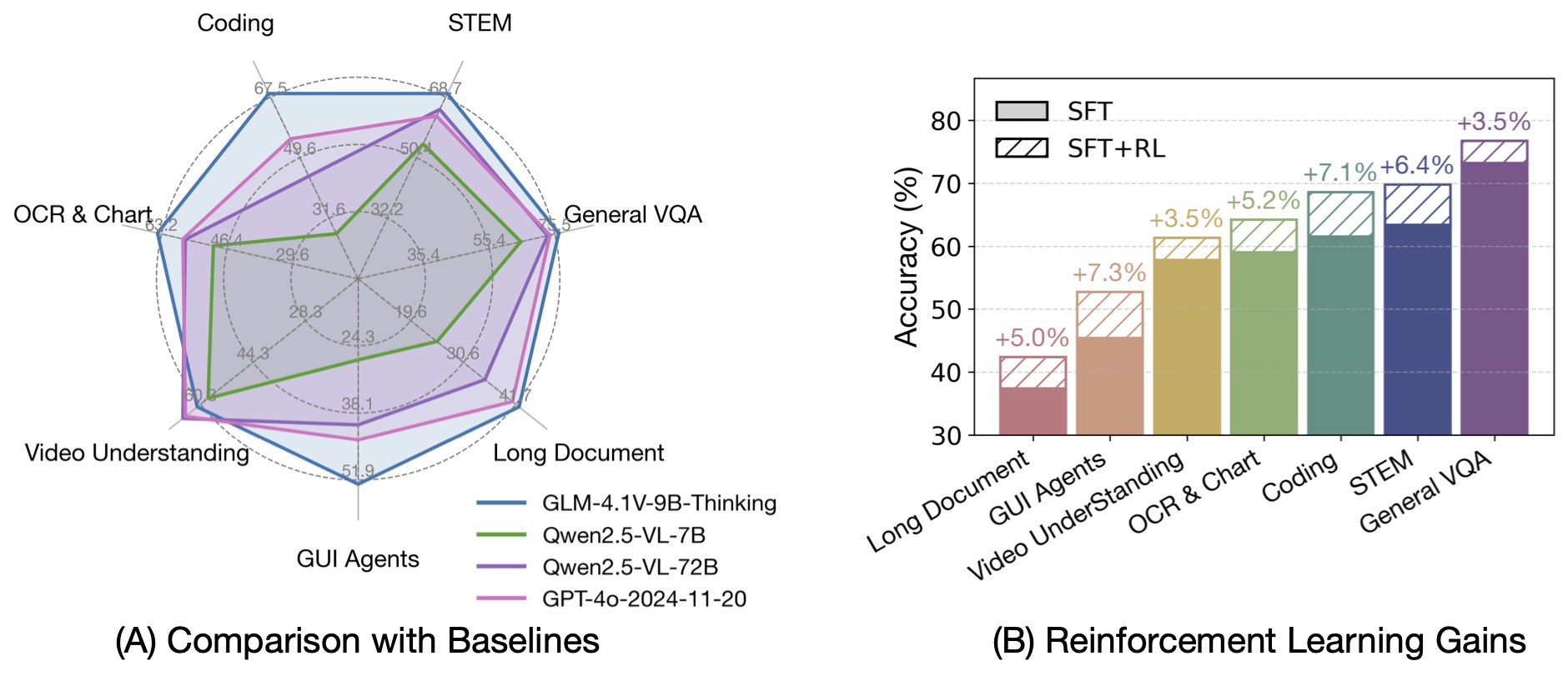
| **GLM-4.1V-9B-Thinking**, designed to explore the upper limits of reasoning in vision-language models. By introducing
|
| a "thinking paradigm" and leveraging reinforcement learning, the model significantly enhances its capabilities. It
|
| achieves state-of-the-art performance among 10B-parameter VLMs, matching or even surpassing the 72B-parameter
|
| Qwen-2.5-VL-72B on 18 benchmark tasks. We are also open-sourcing the base model GLM-4.1V-9B-Base to
|
| support further research into the boundaries of VLM capabilities.
|
|
|
| 
|
|
|
| Compared to the previous generation models CogVLM2 and the GLM-4V series, **GLM-4.1V-Thinking** offers the
|
| following improvements:
|
|
|
| 1. The first reasoning-focused model in the series, achieving world-leading performance not only in mathematics but also
|
| across various sub-domains.
|
| 2. Supports **64k** context length.
|
| 3. Handles **arbitrary aspect ratios** and up to **4K** image resolution.
|
| 4. Provides an open-source version supporting both **Chinese and English bilingual** usage.
|
|
|
| ## Benchmark Performance
|
|
|
| By incorporating the Chain-of-Thought reasoning paradigm, GLM-4.1V-9B-Thinking significantly improves answer accuracy,
|
| richness, and interpretability. It comprehensively surpasses traditional non-reasoning visual models.
|
| Out of 28 benchmark tasks, it achieved the best performance among 10B-level models on 23 tasks,
|
| and even outperformed the 72B-parameter Qwen-2.5-VL-72B on 18 tasks.
|
|
|
| 
|
|
|
| ## Quick Inference
|
|
|
| This is a simple example of running single-image inference using the `transformers` library.
|
| First, install the `transformers` library from source:
|
|
|
| ```
|
| pip install git+https://github.com/huggingface/transformers.git
|
| ```
|
|
|
| Then, run the following code:
|
|
|
| ```python
|
| from transformers import AutoProcessor, Glm4vForConditionalGeneration
|
| import torch
|
|
|
| MODEL_PATH = "THUDM/GLM-4.1V-9B-Thinking"
|
| messages = [
|
| {
|
| "role": "user",
|
| "content": [
|
| {
|
| "type": "image",
|
| "url": "https://upload.wikimedia.org/wikipedia/commons/f/fa/Grayscale_8bits_palette_sample_image.png"
|
| },
|
| {
|
| "type": "text",
|
| "text": "describe this image"
|
| }
|
| ],
|
| }
|
| ]
|
| processor = AutoProcessor.from_pretrained(MODEL_PATH, use_fast=True)
|
| model = Glm4vForConditionalGeneration.from_pretrained(
|
| pretrained_model_name_or_path=MODEL_PATH,
|
| torch_dtype=torch.bfloat16,
|
| device_map="auto",
|
| )
|
| inputs = processor.apply_chat_template(
|
| messages,
|
| tokenize=True,
|
| add_generation_prompt=True,
|
| return_dict=True,
|
| return_tensors="pt"
|
| ).to(model.device)
|
| generated_ids = model.generate(**inputs, max_new_tokens=8192)
|
| output_text = processor.decode(generated_ids[0][inputs["input_ids"].shape[1]:], skip_special_tokens=False)
|
| print(output_text)
|
| ```
|
|
|
| For video reasoning, web demo deployment, and more code, please check
|
| our [GitHub](https://github.com/THUDM/GLM-4.1V-Thinking). |